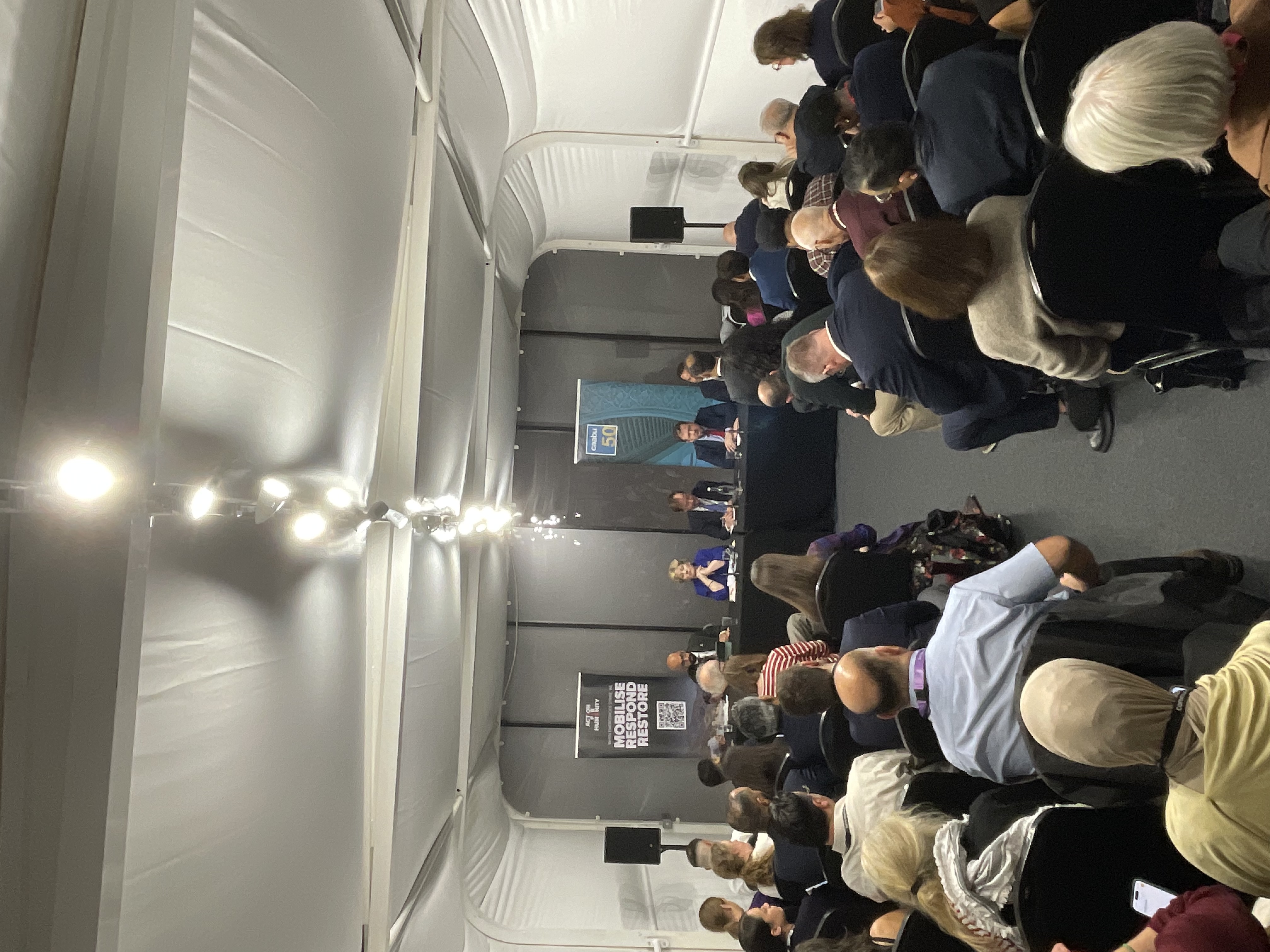
Middle East Minister Stephen Doughty MP pledges tougher line on Israel at Caabu/Action for Humanity Labour Party Conference Middle East Question Time
On 27 September, Caabu and Action for Humanity hosted a Middle East Question Time event at Labour Party Conference in Liverpool. On the panel were the Middle East Minister, Stephen Doughty MP, Chair of the Foreign Affairs Select Committee Dame Emily Thornberry, Salman Shaikh, founder and CEO of the Shaikh Group and Othman Moqbel, advisor and former CEO of Action for Humanity. It was chaired by Caabu Director, Chris Doyle.
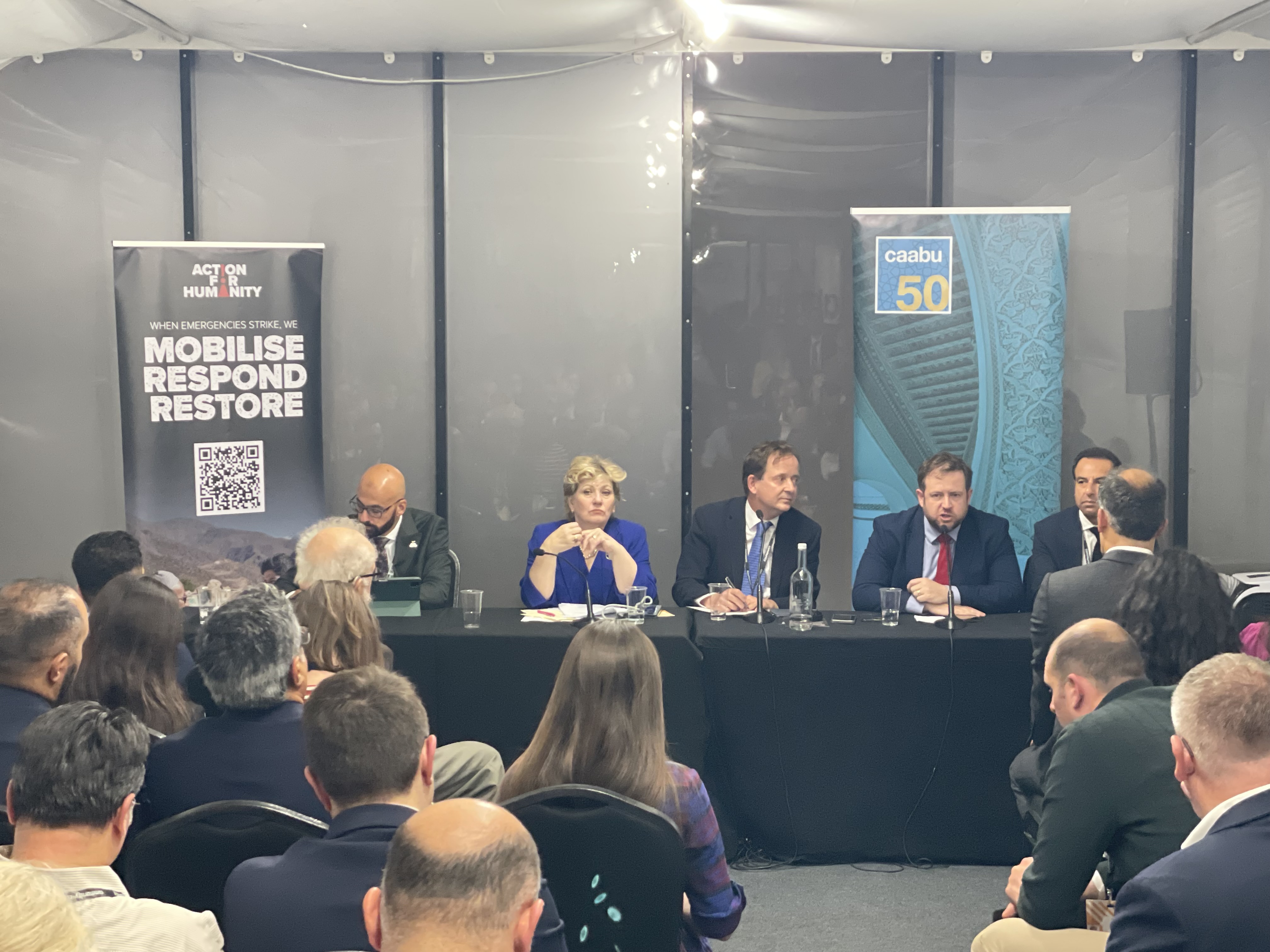
At the event, the Middle East Minister Stephen Doughty said that the UK is taking a significantly harder line on Israel’s conduct in the occupied Palestinian territory, acting on international law. He reiterated what the Government had concluded, stating explicitly that Israel’s occupation was unlawful. He confirmed that the measures, including a ban on settlement trade and services, announced by the Foreign Secretary Ed Miliband on 8 September, includes all territories under illegal Israeli occupation, extending to East Jerusalem and the Golan Heights. He said:
“If you have those values, you have the facts on the ground, you take a legal position, then you have to act. That is why we took the decisions that we have done around banning trade in settlement goods, also tackling services that are facilitating the expansion, and, quite frankly, just calling things out for what they are.”
He also praised the work of the human rights community, and said:
“I also wanted to pay tribute — and I don’t think this happens enough — to the humanitarians, to the aid workers, to the peacebuilders, to the peacemakers, to those who engage in quiet diplomacy and actions, whether at community level or international diplomatic level, to try to find different futures and different pathways forward.
There are many of you involved in these efforts in this room. Some of you will never be able to talk about some of it; some of it will never make it to the news headlines. But all of it is crucial. We know that from finding pathways forward in other conflicts, including in our own neighbourhoods in the past.”
The Minister criticised Israel’s restrictions on aid to Gaza, and spoke on his visit to El Arish in Egypt. He said it was “unfathomable” that essential medical equipment and other supplies were being prevented from entering Gaza. The government says its £88m package will fund medical treatment, water, sanitation and psychological support, but explicitly acknowledges that it is not enough. The UK is calling for restrictions on humanitarian access to be removed. He spoke about meetings had with UK doctors who had been to Gaza, and highlighted that it wasn’t just people who were dying as a result of Israel’s bombing, but also from chronic conditions and lack of access to medical treatment and supplies. Deaths that, under most other circumstances, would have been avoided.
Doughty was clear in his condemnation of Israeli Defence Minister Israel Katz's comments about “finishing the job”, and ethnically cleansing and forcibly displacing people from Gaza. He said that this must not be allowed to happen. He stated that the UK was pushing for a sustainable ceasefire followed by an interim administration that ultimately moves towards Palestinian control of Gaza as part of a unified Palestinian state.
On Iran, he said “We are united around the fact that Iran can’t have a nuclear weapon. It cannot be allowed to threaten and attack its neighbours, including many of our partners and friends in the Gulf. It cannot be allowed to facilitate proxies and partners to undertake destabilising, violent actions across the region and indeed beyond — whether that be on the streets of Britain, whether it be in Europe, whether it be attacks on Jewish communities, whether it be facilitating the Houthis, or indeed Iranian-backed militias in Iraq who are then attacking the pipelines, or indeed Hezbollah.”
He highlighted that on 8 September, the UK Government also introduced a sweeping set of sanctions against Iran also.
On Yemen, Doughty condemned “the reckless and violent actions of the Houthis” and their attacks on Saudi Arabia. He said that the UK had been providing extensive support: “To now see that descend back into crisis and conflict, hundreds of thousands of people fleeing, women and children affected across the place, is deeply, deeply shocking in a region that’s already suffered so much, and where there are some of the worst poverty indicators across the Middle East.”
On Lebanon, the Minister regretted the ending of the mandate for UNIFIL and expressed the hope a new mechanism could be formed for the Israel-Lebanon border. He spoke of the need for the UK to use its relationships with Gulf and regional partners to prevent conflicts spreading and to protect UK security and prosperity.